It’s Friday evening in Korea. The AdSense review didn’t go my way again this week, I haven’t published anything since last Friday, and I’ve spent more time than I’d like to admit just staring at my accounts. They’re red. Not dramatically red — the boring, grinding kind of red that sits there every time you open the app, asking the same quiet question:
Should I have sold it all back in June?
I’m not going to pretend I’m above that question. I’ve asked it roughly forty times in the past month. So tonight, instead of arguing with myself, I did what I’d do at work: I pulled the actual data and looked at what has really happened over the past three months — to the market, to the exchange rate, and to my accounts.
What the market actually did
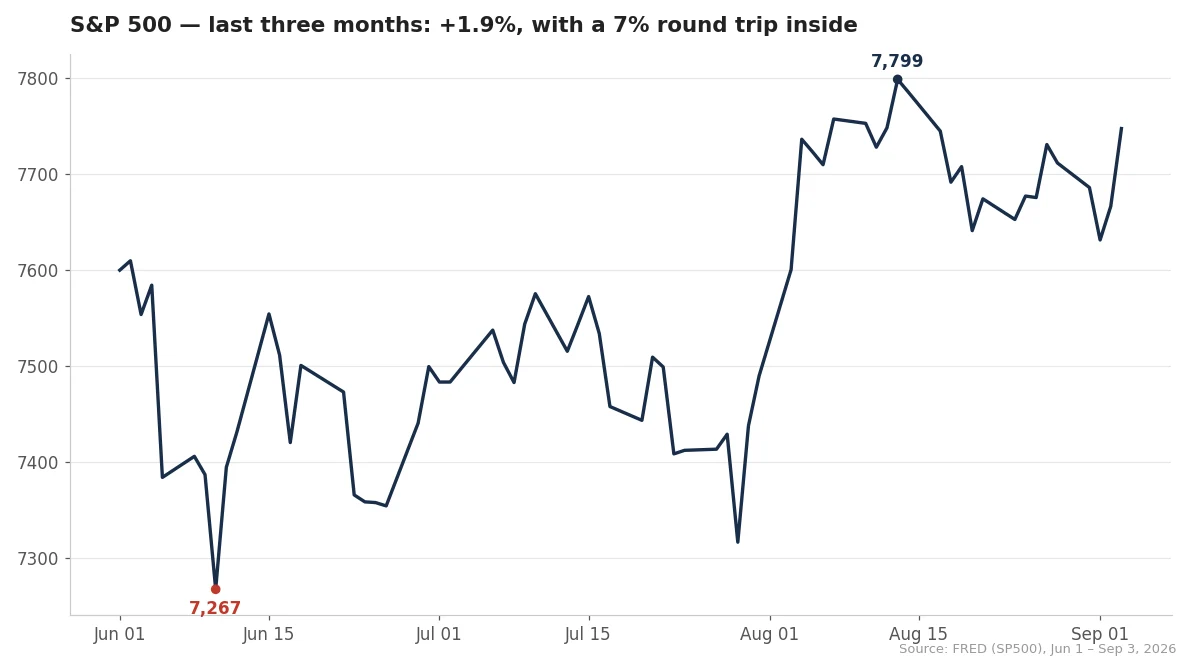
Over three months the S&P 500 went from about 7,600 to about 7,748. That’s +1.9%. A rounding error, almost.
But look at the path. Down to 7,267 in mid-June — that felt like the beginning of something worse, with war headlines and rate-hike talk stacking up. Then a slow, joyless grind back. Then a pop above 7,750 in August. Then another slide. A 7% round trip that ended up almost exactly where it started, except with everyone’s nerves worn thinner. Mine included.
If I had sold at any point during that stretch — and believe me, mid-June was tempting — I would have had to answer a second question nobody talks about: when do you get back in? The honest answer is that I don’t know, and neither does anyone I’ve ever met. The people who sold at 7,267 needed the market to fall further to be right. It didn’t. It never asks first.
The chart that actually explains my red numbers
Here’s the part that took me embarrassingly long to see clearly. My accounts aren’t red because of the S&P 500. They’re red because of this:
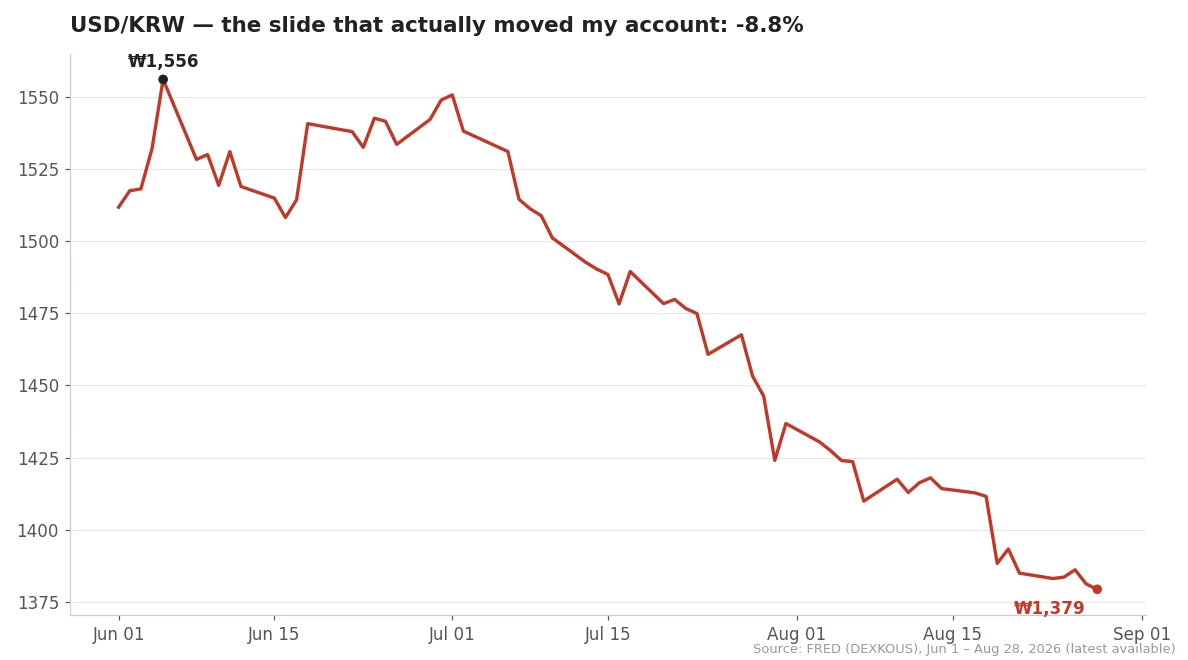
The dollar has fallen from about ₩1,512 to about ₩1,379 in three months — minus 8.8%, and minus 11% from the early-June peak. Almost everything I own is a dollar asset, and my app displays it in won. So even a US Treasury fund that does exactly what it’s supposed to do shows up at −6%, −7% on my screen. Not because the bonds failed. Because the won got stronger.
That realization changes the question. “Should I sell it all?” quietly assumes my investments are failing. They aren’t. The stock side is roughly flat to up; the currency I measure them in moved. And currency moves cut both ways — the same slide that hurts this quarter was a tailwind in other quarters. I’m not going to predict the exchange rate. I couldn’t predict the last three months of it, and neither could the analysts who get paid to.
So here is what I own. All of it.
I’ve shared my totals every month, but today I want to go one step further and show the actual accounts — every fund, every position, as they stand this week. The fund names are Korean (they’re Korean-listed ETFs that hold US assets), and I’m leaving them exactly as they appear in my app. Numbers in won are in won, dollars are in dollars. No dressing up, and as you can see, no hiding the two positions I’m genuinely not proud of.
Pension Savings Account 1 (연금저축, tax-deductible) — ₩70,137,582
| Holding | Shares | Value | Return |
|---|---|---|---|
| KODEX 미국S&P500 | 1,100 | ₩25,982,000 | +1.8% |
| TIGER 미국초단기(3개월이하)국채 | 1,200 | ₩11,208,000 | −5.9% |
| ACE 미국30년국채액티브(H) | 1,000 | ₩7,160,000 | −13.5% |
| KODEX 미국AI전력핵심인프라 | 350 | ₩6,627,250 | −25.2% |
| Cash | — | ₩19,160,332 | — |
Pension Savings Account 2 (연금저축, non-deductible) — ₩48,641,818
| Holding | Shares | Value | Return |
|---|---|---|---|
| TIGER 미국S&P500 | 962 | ₩24,992,760 | +2.8% |
| TIGER 미국배당다우존스 | 1,270 | ₩19,005,550 | +9.0% |
| SOL 미국양자컴퓨팅TOP10 | 200 | ₩4,601,000 | −27.2% |
| Cash | — | ₩42,508 | — |
IRP (Individual Retirement Pension) — ₩10,938,644
| Holding | Shares | Value | Return |
|---|---|---|---|
| SOL 미국배당미국채혼합50 | 501 | ₩5,508,495 | +6.7% |
| KODEX 미국나스닥100 | 207 | ₩5,424,435 | +10.4% |
| Cash | — | ₩5,714 | — |
ISA (Individual Savings Account) — ₩24,388,777
| Holding | Shares | Value | Return |
|---|---|---|---|
| TIGER 미국초단기(3개월이하)국채 | 1,000 | ₩9,340,000 | −7.7% |
| TIGER 미국배당다우존스 | 530 | ₩7,931,450 | −2.7% |
| KODEX 미국나스닥100 | 265 | ₩7,014,550 | −4.4% |
| Cash | — | ₩102,777 | — |
Regular brokerage account (USD) — $3,970.94
| Holding | Shares | Value | Return |
|---|---|---|---|
| VOO (Vanguard S&P 500 ETF) | 1 | $710.81 | +1.0% |
| USD cash | — | $3,260.13 | — |
Put together, at August’s average exchange rate (₩1,404.97 per dollar, averaged from the Fed’s daily H.10 data), that’s about $113,659. Last month’s recap said $113,779. Three months of war headlines, rate decisions, a currency slide, and two ugly thematic positions — and the total moved by about the price of a dinner. That’s what all that anxiety was worth.
Two honest footnotes. The AI-infrastructure fund (−25%) and the quantum-computing fund (−27%) are my own past mistakes, bought the way I’ve written about before — a little at first, then more on every dip. They stay on this list every month as a reminder of what I do when I don’t follow my own rules. And the large cash position in Account 1 is the proceeds from selling most of my 30-year Treasury fund last week — a decision I wrote toward in August, waiting to be redeployed on schedule, not on a feeling.
The answer
No. I’m not selling.
Not because I’m certain the market goes up from here — I have no idea, and this market could stay boring and heavy for another year. Wars don’t resolve on a schedule and central banks don’t either. I’m not selling because the past three months are exactly the environment my plan was built for: prices wobbling sideways, currency noise making everything look worse than it is, and nothing actually broken underneath.
My payday contribution went through this month, same as every month. It bought a little more than it did in June, because that’s what sideways markets quietly do for a monthly buyer. Holding your nerve through a stretch like this isn’t a detour from the goal — as far as I can tell, it is the fastest route there. The account that reaches six figures of passive income will belong to whoever kept feeding it through the months that felt like this one.
The part where I admit this is lonely
One more honest thing, since this post is apparently my confession booth.
I’ve been writing here for two months. A market like this one is easier to sit through when someone is sitting through it with you — and most weeks, this corner of the internet is very quiet. If you’re on a similar road — saving from a paycheck, buying index funds on a schedule, watching your own currency swing your numbers around, wondering some Fridays whether any of it is working — I’d genuinely like to hear from you. What did the last three months look like in your account? Did you sell? Almost sell? The comments are open, no email required, and I read everything.
We might as well be bored together.
Nothing on this site is investment advice — least of all from a man who owns a quantum-computing ETF at minus 27 percent.