
I Sold My House (Part 4): I Had a Four-Year Plan. I’m Already Off It.
On October 8th, the last payment from my house sale cleared. I should be careful with the word “windfall.” I
Personal story and milestones on the road to financial freedom.
On October 8th, the last payment from my house sale cleared. I should be careful with the word “windfall.” I
Every month, same drill: total assets, dividends received, what changed, no dressing up. The starting line was $96,000 and it

After two years of holding a 30-year Treasury fund bought on a rate-cut prediction, I sold 3,120 shares at a 13% loss — and felt like I was finally paying off a debt of my own. The full story, with the chart I should have drawn two years earlier.
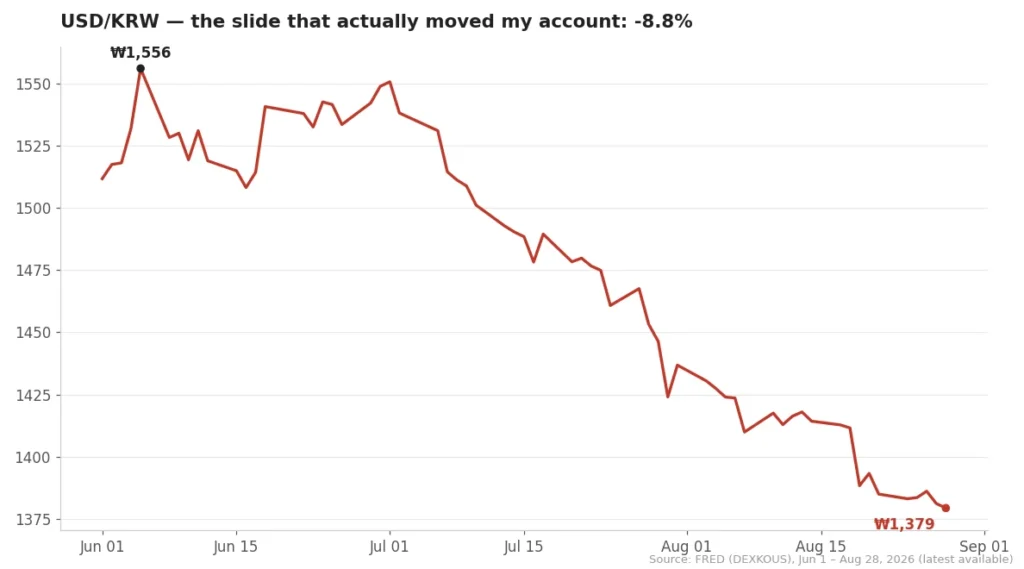
Three months of a sideways market, a sliding exchange rate, and the quiet urge to sell everything. I pulled the real data, opened every account, and wrote down the honest answer.

August 2026: savings reached $113,779 and trailing dividends $174 a month — but in won the same accounts fell 2.5 percent. Here is the change broken into its parts, why the two currencies disagree, and the taxable account that just entered these numbers without earning a cent.

July 2026 was a down month: savings fell about 3 percent to $106,514 while dividends held near $153 a month. Here are the frozen charts, what actually moved the number, how I calculate this every month, and why I did nothing about it.

The house is gone and the first money has landed. So where does it actually go? Here’s my honest, boring, 20-year plan — and why I keep buying index funds even though I’m chasing six-figure dividends.

The first chunk of my house-sale money just landed — and I moved it straight into my ISA. If you are outside Korea, here is what that tax-friendly account actually is, and how it compares to the UK ISA and the US Roth IRA.

Today I signed the papers to sell a house I’ve owned for more than a decade. Most people celebrate selling

The headlines all scream crash: AI bubble, market at all-time highs, 1999 all over again. They might be right. Here are the three simple rules that let me keep investing — and sleep fine — even if a 30% crash hits tomorrow.