Last Monday I opened my pension account, selected 3,120 shares of my 30-year U.S. Treasury fund, and pressed sell.
Here’s the strange part. I was selling debt — literal United States government debt, the safest paper on Earth, held through a Korean ETF. And the feeling, the moment my thumb came down, wasn’t loss or regret. It was the feeling of finally paying off an old debt of my own. Two years of it, gone in one tap. I actually exhaled.
That reaction told me more about the position than any chart ever did. When selling something feels like getting out of debt, you’ve been holding it wrong.

How America’s debt became mine
Two years ago I bought a long-duration Treasury fund (ACE 미국30년국채액티브, currency-hedged) for a reason I was very confident about at the time: everyone said the rate-cut cycle was starting soon. When rates fall, long bonds rise — that part is real math. “Rates will fall soon” — that part, I now understand, was a prediction wearing a fact’s clothing.
Rates didn’t fall soon. The fund fell instead. And I responded the way I’ve responded to every falling position I’ve ever believed in: I bought more. A little at first, then more on every dip, because each dip made the “inevitable” rate cut feel closer. If you’ve read my piece on averaging down, you already know this shape. Same behavior, different asset. The only difference was size: my AI-theme mistake stayed small. This one grew to 18% of my entire portfolio.
Eighteen percent. In a single bet on the direction of interest rates — made by a man whose whole stated strategy is “I don’t predict anything.”
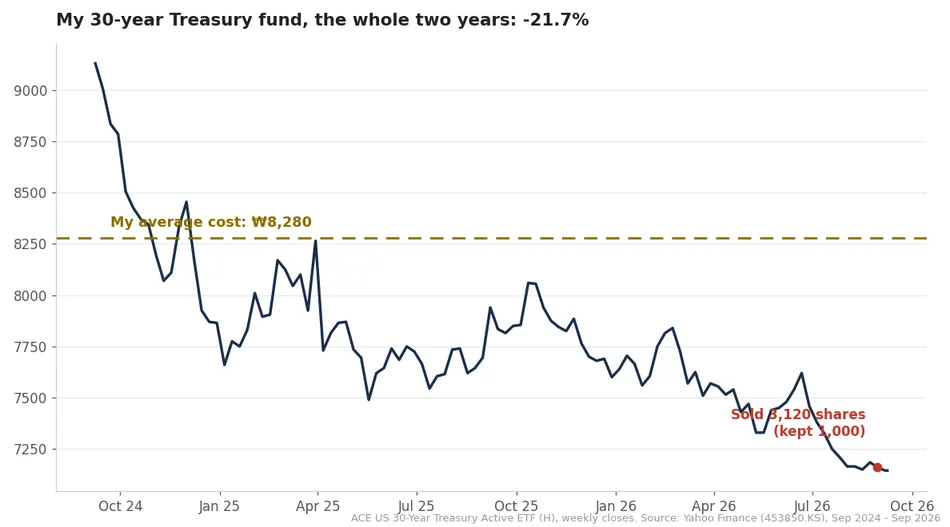
That’s the chart I should have drawn two years earlier. The dashed line is what I paid, on average. Count the weeks the price spent above it. You won’t need many fingers.
The trap: it paid me while it sank
Here’s what made this position so hard to let go of, and why it took two years.
It was simultaneously my biggest loss and my biggest dividend payer. Long-duration Treasury funds throw off real distributions, and every month this thing deposited money into my account like a tenant faithfully paying rent — on a house that was quietly losing value faster than the rent came in.
That combination is a psychological trap I didn’t have a name for until I was in it. The monthly payout feels like evidence the position is “working.” It gives you a reason to wait one more month, and then one more. A position that only lost money would have been easier to face. This one kept handing me small consolation prizes while the principal sank.
So let me do the honest math, with real numbers. Over roughly two years, the fund paid me about ₩1.5 million in distributions. Last Monday, the 3,120 shares I sold went out at a realized loss of ₩3,415,006 — minus 13.21%. The tenant paid on time, every month, and the total rent came to less than half of what the house lost. I ran that comparison many times over two years. I just kept losing the argument to the tenant.
Why last Monday, and why this isn’t a stop-loss
Nothing dramatic happened last Monday. No headline, no margin call, no panic. What happened was slower: in August I finally sat down and asked the position two questions I should have asked at purchase.
First — was my reason for buying a verified fact, or a prediction? It was a prediction. Two years of holding hadn’t upgraded it to a fact; it had just made the prediction older.
Second — does a 30-year Treasury bet belong in my plan at all? My plan is simple, and I’ve written it on this blog since day one: buy broad index funds and dividend funds every payday, let decades compound, build income. Nowhere in that design is “18% directional bet on U.S. interest rates.” I hadn’t added a strategy. I’d smuggled one in, and fed it.
So this sale isn’t a stop-loss, and it isn’t me predicting rates go higher — I’d like to be very clear that I have no idea, which is the entire point. It’s a return to design. Most of the proceeds are sitting in cash right now, waiting for scheduled redeployment rather than for a feeling; I’ve started buying in small pieces, and the full picture will be in the September recap. Removing something that never belonged isn’t losing. It just gets recorded that way.
What I kept, and the only question that matters
I kept 1,000 shares. Partly so the loss stays on my screen where I can see it — I’ve learned I need my mistakes visible, not deleted. And partly because I’m honest enough to admit I couldn’t let go of all of it in one day. Two years of averaging down builds attachment. I’m working with the man I am, not the one I’d like to be.
Will I buy long Treasuries again someday? Wrong question. The question I’ve promised myself to ask first is: would I have a reason that’s a fact, not a forecast? Until that answer changes, the answer is no — at any price, in either direction of rates.
Two years ago I lent America money because everyone around me agreed it was the smart, safe thing to do. Last Monday I took most of it back, poorer in won and richer in exactly one thing: I now check whether my reasons are facts before I let them near my payday money.
America, no hard feelings. You never promised me a rate cut. Nobody did, actually. We all just hoped for it out loud, together, until it started to sound like a promise.
Nothing on this site is investment advice.